Network Kings, India’s Leading IT Career Training Academy
- Email: support@nwkings.com
- SCO 41-43, B Block, 4th floor, Chandigarh Citi Center



The Cisco Certified Network Associate (CCNA) certification is a globally recognized entry-level certification for IT professionals who want to build a career in networking. Earning this certification validates your fundamental networking knowledge and skills, proving your competency in installing, configuring, operating, and troubleshooting small to medium-sized networks.
However, even with dedication and hard work, passing the CCNA can feel like climbing a mountain. This blog delves into the essentials of the CCNA certification, prerequisites, critical topics, and some unconventional tips to help you conquer the challenge to clear the CCNA certification exam.
What is the CCNA Certification Exam?
The CCNA certification exam (200-301) tests your understanding of a broad range of networking concepts and technologies. It’s not just about rote memorization; it’s about demonstrating your ability to apply your knowledge in practical scenarios. The exam covers topics like:
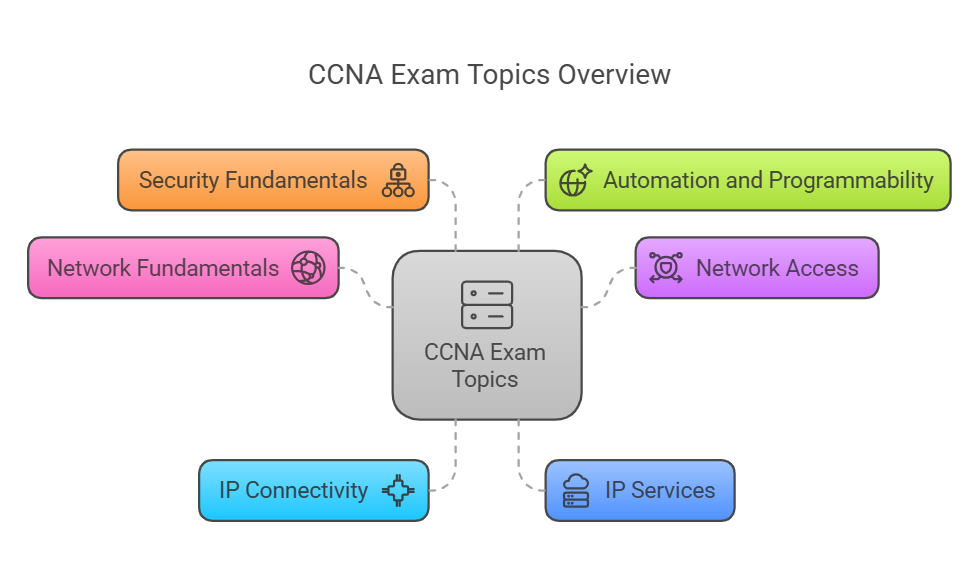
- Network Fundamentals: IP addressing, subnetting, OSI model, TCP/IP model, network topologies, cabling.
- Network Access: VLANs, spanning tree protocol (STP), port security, EtherChannel.
- IP Connectivity: Routing protocols (OSPF, EIGRP), static routing, inter-VLAN routing.
- IP Services: DHCP, DNS, NAT, QoS.
- Security Fundamentals: VPNs, firewalls, access control lists (ACLs).
- Automation and Programmability: Basic understanding of network automation concepts.
The exam consists of multiple-choice questions, simulations, and drag-and-drop exercises. It’s designed to assess your real-world skills and understanding, not just your theoretical knowledge.
Prerequisites for the CCNA Exam
While there are no official prerequisites to take the CCNA 200-301 exam, having a basic understanding of networking concepts and computer technology is highly recommended. Some helpful background knowledge includes:
- Basic computer knowledge: Familiarity with operating systems like Windows or Linux.
- Basic networking concepts: Understanding of IP addresses, network devices, and basic network topologies.
- Some experience with command-line interfaces (CLI): Experience navigating and executing commands in a command-line environment.
Although not mandatory, prior IT experience or completing entry-level networking courses can significantly improve your chances of success.
Important Topics to Cover for CCNA Certification
While the entire CCNA syllabus is crucial, some areas deserve extra attention due to their complexity and frequency in the exam:
- Subnetting: Mastering subnetting is essential. Practice until you can quickly convert between binary, decimal, and hexadecimal representations, and calculate network addresses, broadcast addresses, and usable host ranges. Use online subnet calculators to check your work, but don’t rely on them as a crutch.
- Routing Protocols (OSPF & EIGRP): Understand the fundamentals of link-state (OSPF) and distance-vector (EIGRP) routing protocols. Focus on neighbor discovery, route selection, and convergence.
- Spanning Tree Protocol (STP): Grasp the core concepts of STP, including root bridge election, port states, and the various versions of STP (including PVST, Rapid STP, and Multiple STP).
- VLANs and Inter-VLAN Routing: Understand how VLANs segment networks and how inter-VLAN routing allows communication between different VLANs. Familiarize yourself with router-on-a-stick and Layer 3 switching.
- Security Fundamentals: Learn about different security threats and mitigation techniques. Understand how to configure and troubleshoot access control lists (ACLs).
Top Tips to Crack the CCNA Certification Exam (No One Talks About!)
Here are some less-conventional, but highly effective, tips to help you pass the CCNA certification exam:
- Beyond the Book:
Emulate Real-World Scenarios: Don’t just passively read textbooks. Build a virtual lab using GNS3 or Cisco Packet Tracer and actively configure devices, troubleshoot network issues, and simulate real-world scenarios. The more hands-on experience you gain, the better you’ll understand the concepts.
- Think Like a Network Engineer:
Develop a problem-solving mindset. When faced with a problem, break it down into smaller, manageable steps. Use the scientific method: formulate a hypothesis, test it, and analyze the results. This approach will help you troubleshoot network issues effectively.
- Master the Command Line Interface (CLI):
The CLI is your primary tool for configuring and managing Cisco devices. Become proficient with the common commands, learn how to use the help system, and practice troubleshooting using the CLI.
- Don’t Neglect the “Small” Stuff:
Pay attention to seemingly minor details like cabling standards, console connections, and fundamental network protocols. These smaller topics often appear in the exam and can make the difference between passing and failing.
- Practice Time Management:
The CCNA exam has a time limit. Practice answering questions under timed conditions to improve your speed and accuracy. Learn to identify questions you’re struggling with and move on to easier questions first.
- Understand Why, Not Just What:
Don’t just memorize commands; understand why they work. Learn the underlying principles and how different technologies interact.
- Join a Study Group (or Start One):
Collaborating with other aspiring CCNA candidates can significantly enhance your learning experience. Share knowledge, discuss challenging concepts, and quiz each other.
- Don’t Cram, Space Out Your Study Sessions:
Avoid cramming information right before the exam. Instead, space out your study sessions over several weeks or months. This technique, known as spaced repetition, helps you retain information more effectively.
- Take Breaks and Prioritize Well-Being:
Burnout is a real threat. Take regular breaks to rest and recharge. Prioritize your physical and mental health. A well-rested and focused mind is essential for success.
- Don’t Give Up:
The CCNA exam is challenging, but it’s also achievable. If you fail the first time, don’t be discouraged. Analyze your mistakes, identify your weak areas, and keep practicing.
The Bottom Line
Passing the CCNA exam requires dedication, perseverance, and a strategic approach. By understanding the exam objectives, mastering the key concepts, adopting effective study techniques and applying the unconventional tips outlined above, you’ll be well on your way to earning your CCNA certification and launching a successful career in networking. Good Luck!
FAQs:
- What is the format of the CCNA certification exam?
The CCNA certification exam (200-301) consists of multiple-choice questions, simulations, and drag-and-drop exercises that assess your understanding of various networking concepts. It’s designed to evaluate your ability to apply knowledge in practical situations rather than just memorizing facts.
- Are there any prerequisites for taking the CCNA exam?
There are no official prerequisites for the CCNA 200-301 exam. However, having a basic understanding of networking concepts, and computer technology, and some experience with command-line interfaces (CLI) is highly recommended to increase your chances of success.
- What key topics should I focus on while studying for the CCNA exam?
Important topics to cover include subnetting, routing protocols (OSPF and EIGRP), Spanning Tree Protocol (STP), VLANs and inter-VLAN routing, and security fundamentals. Mastering these areas will help you tackle the more complex questions on the exam.
- What are some effective study techniques for passing the CCNA exam?
Some effective study techniques include building a virtual lab for hands-on practice, joining or starting a study group, spacing out study sessions instead of cramming, and practicing time management during practice exams. Additionally, focus on understanding concepts rather than just memorizing commands.
- What should I do if I fail the CCNA exam on my first attempt?
If you don’t pass the CCNA exam on your first try, don’t be discouraged. Analyze your mistakes to identify weak areas, continue practicing, and consider seeking additional resources or support. Persistence and targeted study can lead to success in your next attempt.